Old Salsa Photos Thread

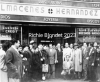
From 1945 located at Madison Avenue & E. 114th Street. The Almacenes Hernandez, formerly known as the "Casa Hernandez Record Shop" that was originally owned by the legendary composer Rafael Hernandez. The business was managed by his sister Victoria Hernandez. Who, in 1939, sold the store to music retailer and record label owner Luis Cuevas in her attempt to join her brother in Mexico (where he had been residing since 1932) and establish a similar business there. Only to discover that Mexican law at that time forbade any business in Mexico to be owned by non-Mexican born citizens. Thus Victoria returned to NYC and established the second Almacenes Hernandez shop. Only this time in the Bronx. In 1969 Victoria sold the shop and it's inventory to guitarist and composer Miguel Angel Amadeo. The son of a musical contemporary of Victoria and Rafael (and, like his son Mike, a prolific composer himself, who authored one of the earliest Bolero-Guarachas entitled "Idilio." Made popular and introduced to a new generation with a new arrangement by Angel "Cucco" Peña, recorded by Willie Colón in the early 1990s) who rebranded the business as "Casa Amadeo." However Mike maintained an awning just below the Casa Amadeo sign that read "Antiguo Almacenes Hernandez, " to remind the public of the site's legacy. Back in 1939, Luis Cuevas did the exact same thing. Although incorporation papers identified the store as the Luis Cuevas Music Shop, he too preserved the "Almacenes Hernandez" sign above the front entrance.

Among the crowd gathered outside the store are a handful of luminaries of Cuban Popular Music in New York. Including Catalina Rolon, Noro Morales, Pedro "Piquito" Marcano, Miguelito Valdes and Rene Hernandez.
Screen Shot 2020-06-12 at 7.45.37 PM~4.png
 

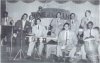
Nice! This is a rare photo of TRod's early conjunto. I'd estimate this photo was captured in 1950. Before Tito amplifies his orchestra to 10 pcs in '51. And shortly prior to Little Ray Romero joining the band on bongo in '53 upon exiting the Miguelito Valdes orchestra.

One thing I learned about photos at the Palladium captured by Harry Fine was how to estimate a time frame based on the signage in back. From April 1946 to March 1950 there was no signage and just a plain empty curtain. From April-May 1950 the owner had the sign you see in the photo added ("Palladium: Home of the Mambo"). It wasn't until 1954 that two additional smaller signs were added on either side of that sign. One on the left that read "Merengue." With one on the right that read "Cha Cha Cha."

From L-R: Joe Loco (who played w/ Tito Rodriguez and the Julio Andino Orchestra for a quick minute before launching his own and more popular ensemble), Tito Rodriguez (lead vocals; maracas), Luis Barreto (bass), Ramon "Monchito" Munoz (timbales), Al Stewart (trumpet), Johnny "La Vaca" Rodriguez (bongo), **** Smith (trumpet), Harold Wegbreit (trumpet), Wilfredo "Chonguito" Vicente (tumbadora).
 
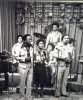
Another gem from Club Broadway
View attachment 4138

Hmm? Interesting. I don't recall that event being billed as a 25th Anniversary Show. I recall it as being just a regular Saturday night billing between Larry Harlow's orchestra w/ Junior and Nestor Sanchez as invited guest vocalists (singers Cali Aleman & Emo Luciano were also on this date) and Pacheco y su Tumbao Añejo w/ Hector Casanova on vocals. 1992 as Harlow's 25th anniversary seems off. Making Larry's debut in '67. Which isn't accurate as he was already around leading the Orchestra Harlow prior to that. I guess it could just have been a promotional gimmick? Two years later (1994) was the Fania record label's 30th anniversary concert tour (Puerto Rico, Miami and Madison Sq. Garden in NY). If Larry was supposed to be the label's first artist to sign a contract (there's an account that has Bobby Valentin being the earliest or just prior to Harlow to sign w/ Fania Records), then 1992 would have been his 27th Anniversary if one goes by debut LPs. The "Heavy Smokin'" LP came out in '65. But, again, it was probably just a promotional thing. Most only recognize or commemorate a Silver Anniversary (25 years) or Gold (50).
 
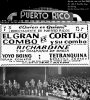
Not a captured photo but a mock image using photography and print media. This event too place on May 28, 1966 at the fabled Teatro Puerto Rico. The most significant performance venue in NYC revolved around Latin American entertainment. It's "golden era" ran from 1948 to 1967 (from a certain perspective).

On this evening El Gran Combo went head to head with their old boss Rafael Cortijo and his new bunch.

Singer Ismael Rivera was not in tow.

img_1_1680874685271~2.jpg
 
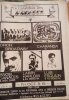
View attachment 4136 I need a translation for this as well. I assume for letter combination means it's an US radio station. But who are these people and what do they do?


Also I noticed that some of the top artists are called patato and chocolate. Was there a trend at that time to name yourself after some kind of food?
 

Attachments

  • 335276136_932280968191964_6404701334860304097_n.jpg
    335276136_932280968191964_6404701334860304097_n.jpg
    81.4 KB · Views: 2
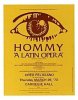
A Latin Opera, the first opera in the history of salsa. It was held on Thursday, March 29, 1973 at Carnegie Hall in New York. The musical brought together several salsa stars under the direction of Larry Harlow.
View attachment 4153

Since what Larry Harlow played was Afro-Cuban music it actually isn't the first "Salsa Opera." Musical theater, particularly in Cuba, Puerto Rico and New York, is a tradition that goes back to, at least, the 19-teens. Stories or narratives illustrated through music and or dance.

"Hommy" was part of that legacy.
 
Since what Larry Harlow played was Afro-Cuban music it actually isn't the first "Salsa Opera." Musical theater, particularly in Cuba, Puerto Rico and New York, is a tradition that goes back to, at least, the 19-teens. Stories or narratives illustrated through music and or dance.

"Hommy" was part of that legacy.

Perhaps I should have written, it was Billed as the first Salsa Opera

"In 1972, salsa was at its height. Larry Harlow, known as “The Marvelous Jew,” was contemplating the idea of a new musical concept for the Afro-Caribbean music scene. Inspired by the success of the rock opera “Tommy,” Harlow got ready to unveil a similar concept, designed for the salsa market.

The idea came to life in 1973 with the opera “Hommy” (lyrics penned by Heny Álvarez) that told the story of a boy who was born deaf and blind, but had an enormous talent for percussion. Here, the greatest musicians of the time came together: Justo Betancourt, Cheo Feliciano, Adalberto Santiago, Junior González, and Pete “El Conde” Rodríguez, not to mention the woman who would later become the “Queen of Salsa”: Celia Cruz.

This group of artists did their duty with a recording that took a place of honor in the history of Afro-Caribbean music, with a radiant performance that captured the attention and imagination of salsa fans around the world. This production also has the important distinction of being the first recording that earned Celia Cruz success in the US salsa market. Almost by accident, Harlow met Celia Cruz in Mexico, and told her he wanted a female voice for his opera. At the same time, Jerry Masucci was considering Celia as an alternative to the musical authority of La Lupe, who was at that time considered “The Queen of Latin Soul.”

Celia Cruz went to New York to meet with Masucci and discuss the possibility of recording with the Fania label; when she arrived, she discovered that her meeting was in the same studio where “Hommy” was being recorded. Celia told me, “I got so angry, and I’m not an angry person. They had me all set up to sing ‘Gracia Divina,’ which I had never even heard. But I learned it and I sang it.” “Gracia Divina” was an enormous hit, and opened the doors of success to Celia Cruz, who immediately recorded “Bemba colorá” with the Fania All Stars. The rest is history.

The musical and rhythmic variation in “Hommy” offers an amalgam of traditional Cuban music, in wonderful arrangements by Larry Harlow. This is a veritable representation of the state of salsa music in the early 1970s. During that time, violins began appearing in salsa music, and figure prominently in “Hommy.” This recording presents salsa at maximum capacity, and is an indisputable achievement of Larry Harlow’s musical magic. The tracks “Es un varón,” “El día de Navidad,” “Quirinbomboro,” “Gracia Divina,” “Cari-Caridad,” and “Soy sensacional” were undeniable worldwide hits that became dance numbers and points of discussion among salsa musicians. This was the first time that a Spanish-language, salsa-themed opera had ever been presented to the masses.

The opera ends with a chorus of pleas to the spiritual forces of the universe to end suffering on earth and the war in Vietnam through divine grace and charity. At the same time, there is the resignation of the people, who prefer vacillation, not sermons on sensible living. “Hommy” opened the doors for this kind of performance to the salsa market. The opera enjoyed great success in Puerto Rico. Through “Hommy,” salsa took on a sophisticated air, and this legacy opened the doors for the Afro-Caribbean musical tradition to enter the most prestigious performance halls in the world.

This is the legacy of “Hommy,” one of the best recordings of the era. It brought the best musicians of the genre together in a musical expression that transcended time; simultaneously, it introduced Celia Cruz to the salsa market and planted her firmly in the throne that she never left. More importantly, however, “Hommy” took salsa to a new level with the public, proving that the genre belonged in the best performance halls in the world. From that moment on, salsa became dancehall music, and it has this record to thank for it. (Written by Juan Moreno Velázquez)"

 
Back
Top