Leads: does dancing with follows in heels vs. flats feel different?

Does dancing with follows in heels or flats feel better?


  • Total voters
    12

Sabrosura

Son Montuno
So I'm curious whether leads feel any difference when dancing with a follow who is in heels vs. flats -- especially if you have danced with the same follow in both heels and flats (since some follows only dance in one or the other).

Personally, I feel like I dance better in flats -- better floor connection, which makes everything better.

Frankie (who was my main instructor) is so anti-heels -- because of the negative impact on floor connection & dancing in general -- that he does not allow follows in his classes to wear heels. At the time I thought this was a bit extreme, but over time I have come to see that heels really do affect floor connection quite significantly. When I dance in flats (especially thin soled jazz shoes), I can grip the floor with the entire foot, which allows for a freedom of movement that heels just don't allow to the same degree.

That said, I'm not sure if that difference -- which feels quite significant to me -- is also felt by the leads I am dancing with.

Curious to hear from the leads if you notice any difference in dancing with follows who are in flats vs. heels.
 
I voted for the 3rd option - can't tell the difference.

Footwear is the last thing I look at and I have zero preference in this debate.

Can't feel the difference either, but that may be because followers wearing heels overwhelmingly outnumber those who don't.

AFAIK, all of my favorite follows don't feel any different wearing either.
 
Recently at the Prague salsa marathon -- which to me has the best social dancers out of the salsa festivals I have been to -- I noticed most of the follows were in flats.

Over here and at the festivals I've been to, it's mostly heels during night parties.

Come to think of it, followers seem to ditch the heels when dressing up isn't required like at an afternoon social, but again, I haven't noticed any difference in how they feel.
 
I find follows with low heels dance lighter but still grounded. Flats feel slightly heavier and too high, feel a tad less connection
 
I can feel a difference between sticky shoes and non-sticky shoes. Heels tend to be non-sticky compared to sneakers. But not sure if I can tell a difference between heels and non-heels if they have the same level of stickiness.
 
I chose flats by a narw margin to does matter based on the amount of inexperienced follws I dance with bei g noticeably more unbalanced than in flats. If it was just experienced follows (very rare for me ) it would be forsnt matter, though I go with low heels.
 
Flats feel slightly heavier

I think that tends to happen if someone who mostly dances in heels dances in flats every now and then: the high heels make it easier to place the weight on the ball of the foot, so when someone who mostly dances in heels starts dancing in flats, some extra work is needed for a while to actively keep the weight front-loaded, otherwise her weight will go towards the heel and she will thus feel heavier.

After the adjustment period though, this becomes automatic (also, some foot muscles that usually are dormant when dancing in heels will become activated and the foot will begin to connect with the floor much better than in heels) and she should feel even lighter than in heels (at least I do). But for someone who only dances in flats infrequently, that adjustment will not happen and she will indeed feel lighter in heels and heavier in flats.

One thing to note though is the type of flats matter. Sneaker-type shoes, thick soled shoes, etc. will indeed feel heavier than thin soled shoes/jazz shoes. I can dance in sneaker type dance shoes for Cuban and with most "average" linear salsa leads, but if I'm dancing with a very precise & very light salsa lead, sneaker dancer shoes don't cut it, I feel the need to switch to jazz shoes.

Also, I think flats that don't have any kind of heel/sole support, like ballet shoes, don't work as well as flats that do have a little bit of heel and sole support, like jazz shoes.
 
Last edited:
Another reason why I may not notice the difference is that those who frequently dance in heels may try to preserve their technique by simulating dancing in heels when not wearing heels. I have seen this with some of the more experienced dancers.
 
I have danced with many follows with both types of shoes and in the majority of cases they were far superior in flats. (Flats here jazz and ballet shoes.)
The one exception is spinning, where the strength of (good) heeled shoes comes into play.
But once you add in body movements - specially outside the canned basic stylings - and foot mobility outside of rehearsed spin patterns, flats are far superior.

Also the stress on the feet seems to be far lower on flats, allowing follows to dance for longer without having to take a break due to pain issues. That's why flat dance shoes were known as "trainers" when I was younger.

That said, in some environments you will find that all advanced follows are trained into heels as the only option and optimized their movement completely around that, never really learning to dance in flats.
But I am speaking of follows who are well trained in both.

Also bad flats - i.e. sneakers with bad sole, heavy soles, socks - simply aren't tailored for high profile movement on a fine parquet, thus should not be compared to expensive, high quality dance shoes.
 
The one exception is spinning, where the strength of (good) heeled shoes comes into play.

In my experience this has more to do with training the foot / leg / core muscles -- having danced mostly in flats for the last couple of years, I now actually spin just as well as in heels (if not better) in my jazz shoes, and the better floor connection with jazz shoes makes stopping my spins, in particular, more precise / with faster reaction than in heels; I can go into and stop a triple/quadruple/quintuple spin (yep I have gotten a couple quintuples lately :D ) with just the tiniest lead signal, including if e.g. the lead changes his mind at the last moment and adds an extra spin or decides to stop me early. I feel like my spins, in flats, are now the best they have ever been.

I also do resistance training for core/leg muscles regularly and I think this is an essential element for good spinning, and if those muscles are strong than spinning in flats should be just as good as in heels (or better).

Another point here for technique and muscle strength being essential is that ballet dancing, who are probably the best spinners, spin in flats. Also FM's spinning technique (which to me is the best) is targeted to spinning in flats (though of course similar principles /muscle training would allpy to heels).

It is also crucial, as I mentioned above, to have proper front-loading of the weight in flats for proper spinning. And if someone mostly dances in heels, they most likely will have a more difficult time spinning in flats.

Enjoyed reading your observations on this topic :)
 
Last edited:
That said, in some environments you will find that all advanced follows are trained into heels as the only option and optimized their movement completely around that, never really learning to dance in flats.

Yes, and if you only dance in heels then trying to dance in flats at first feels pretty bad, because you're not used to actively having to keep your weight on the ball of the foot, so there is the tendency to let the weight go on the heel, which results in heavier/more cumbersome dancing. Heels act like a crutch in this regard, and when the crutch is gone, it shows the real state of the dancer's weight-placing technique. I have some videos from my beginner salsa times when I first tried dancing in flats and it was pretty cringy to see my weight going towards the back of the foot.

Also, heels usually make dance movement seem more gracious, even if it is in fact of worse quality than a dancer who is well-trained in dancing in flats. Heels also make it somewhat easier to engage the leg extension muscles (hamstrings and glutes) when stepping, which most people don't otherwise engage well but which are crucial for good dance movement; whereas in flats it takes more conscious focus to engage those muscles well. So heels can create the illusion of "better dancing" and when this "crutch" is removed and the person dances in flats, it really shows what the dancer needs to improve in their dance movement/stepping. So dancing in flats is also a great teaching tool if used well.
 
During corona time I made lots of private classes with three different female instructors, and they often switched from heels to flats (because of aching feet mostly). I never noticed a better or worse lead with that.

Only thing I noticed of course was different height of them. All three were rather small, so I was fine with all combinations. Very smalls girls (like 1,55 m) look better on heels. On the other hand I don't like it when taller girls use heels and reach my height, because that makes spins more difficult as I need to step on my toes. So having read your opinion I would just recommend taller girls to not use heels and use flats instead.

So the question arises: why did it start at all that followers use heels? We also all know heels make feel pain after some hours dancing. Is it just because women think they look much better in it? I never felt women in heels to be more attractive (except for the very small girls, as I mentioned above). Or is it because some teachers tell them it's better for dancing?
 
Curious to hear from the leads if you notice any difference in dancing with follows who are in flats vs. heels.

I don't have preference on whether follower is wearing heels or flats. My only gripe is those followers who will insist on dancing up on their toes when dancing in flat but have problems maintaining their balance. I know followers who will only stay on their toes when in flats and their balance will be rock solid. I know another set of followers who when on their toes in their flats, you can feel them getting slightly off balance.

When wearing flats, I don't really see a reason on why followers have to only stay up on their toes. I had a few discussions and some followers insist it is only the way since it is same as dancing on the heels. The best and most effective followers in the flats I have danced with don't always stay up on their toes (i.e. never touching their heels to the floor).

Among advanced followers, heels or flats makes no difference. But I will say that followers feel slightly better in the flats than in the feels. By flats I mean jazz shoes or flat dancing shoes. Not sneakers.
 
Heels , for dance, distribute weight in the direction one needs. The "balance" for this style of dance requires quick responses and a flat shoe ( no heel ) tends to spread weight over a much larger area of foot .Poise is set naturally to some degree with heels .

Using Ballet as an EG for flat usage is "apples and oranges " .
 
Heels , for dance, distribute weight in the direction one needs. The "balance" for this style of dance requires quick responses and a flat shoe ( no heel ) tends to spread weight over a much larger area of foot .Poise is set naturally to some degree with heels .

That's why I prefer jazz shoes, which have a bit of heel, vs. ballet flats.

For poise, I don't think you need a high heel, especially if you are an experienced dancer. Certainly 10 cm heels are not needed in salsa. The majority of the salsa male population dances in flats (with small heel) and they dance just fine :)

Re: quick responses, I find that in salsa the greater floor contact actually helps in that regard, as in jazz shoes I can "grip" the floor with one foot (which is impossible to do in heels) while quickly and smoothly transferring my weight to the other foot, and the jazz shoes also allow me greater freedom for how I want to distribute my weight between the two feet (different proportions of weight on each in certain kinds of stepping, or if I want to draw out a certain step, e.g. for musical accenting). I also find the sole of jazz shoes a lot better for floor connection than typical ballroom-style heel shoes.
 
This is why I like to have followers with a low heel. Flats I see as literally flat soles (running shoes). Anything that has a heel of any sort 1/2" are the ideal for me. Slightly "on the ready" while still good center of gravity and grounded feel. Stilettos may look nice but not as relaxing as the low heels. I have seen some followers wearing flats go on their heels and spin really well (even sandals!) however I learned later that there are flat running shoes that are designed with something in the ball of the foot which allows for good spinning. Flats, I'm talking about "normal" and not specially designed shoes.
 
This is why I like to have followers with a low heel. Flats I see as literally flat soles (running shoes). Anything that has a heel of any sort 1/2" are the ideal for me.

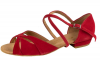
I actually went online today and found "Latin dance shoes" with a 2 cm (3/4 inch) heel, for when I want to wear something a bit "fancier" looking than jazz shoes. Before it was really hard to find low-heeled Latin shoes (other than the very basic black / gold ones for ballroom), so I am glad these options now exist :)

1636308132524.png
 
Back
Top